
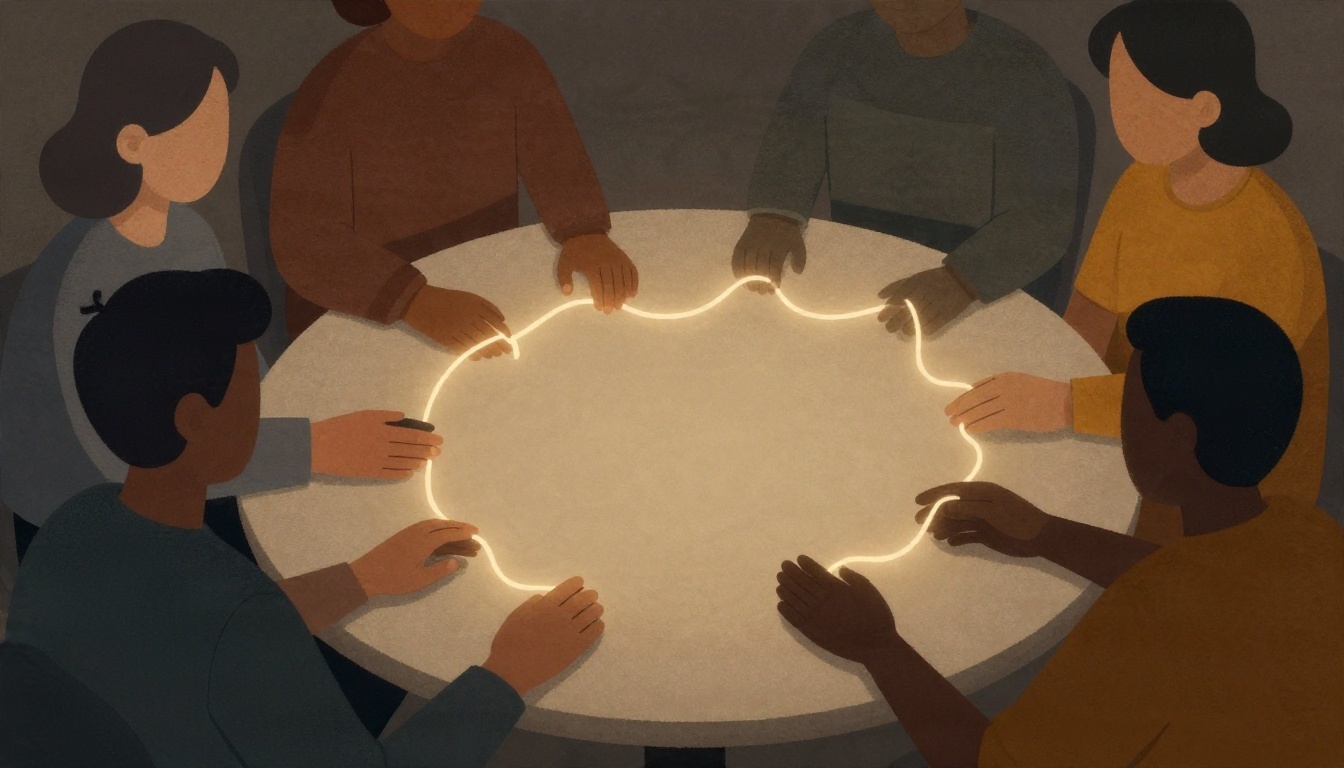
Your team already has rituals: the Monday stand-up, the Friday shout-out channel, the quarterly retro. They happen on schedule, follow the same format, and still feel hollow. People show up, say their lines, and leave without any sense that the ritual means anything. The problem is rarely the ritual itself. It is that the ritual carries no narrative, so it repeats a behavior without transmitting meaning.
According to the research cited, what makes a team ritual create shared meaning rather than empty routine?
Select one answer.
Why rituals need a story to work
Organizational storytelling research treats stories as a way teams make sense of events, transmit values, and negotiate identity. Narrative approaches in organizational studies show that stories shape, reflect, and transform organizational life, and that leaders use narratives to communicate strategy and embed culture (Nature Index). A ritual without a story is just a calendar entry. A ritual with a story becomes a repeated enactment of what the team believes.
Rituals also bridge the visible and invisible sides of culture: they connect the behaviors management expects with what people actually do. Well-crafted rituals leverage storytelling to move people forward, and repeated behaviors become part of the culture's muscle memory (Fearless Culture). That is the mechanism you are trying to activate.
The three layers of a meaningful ritual
Before redesigning anything, separate what a ritual contains:
- The behavior: what people physically do (gather, speak, write, clean, celebrate).
- The story: the narrative that explains why the behavior matters and what it says about the team.
- The meaning: the shared interpretation people carry away and retell.
Most teams design only the behavior. The fix is to attach a story to each existing ritual and make the meaning explicit.
A practical checklist to add narrative to a ritual
Use this sequence on one ritual at a time.
- Name the ritual's purpose in one sentence. If you cannot, the ritual is probably administrative, not cultural.
- Find the origin story. When did this ritual start, and what problem did it solve? If no one remembers, invent a forward-looking story instead: what will this ritual protect as the team grows?
- Choose one story prompt per session. For example, in a retro, ask each person for one moment this quarter when the team helped them. In a shout-out channel, require the giver to say what the action made possible, not just thank the person.
- Make the story visible. Capture it in a shared document, a running log, or a short recap. Narrative repetition, the retelling and circulation of organizational stories, is how stories become part of how the team understands itself (Academy of Management Review).
- Close the loop. End every ritual by stating what the stories revealed about the team's values or direction.
- Review after four cycles. Ask whether people can retell one story from the ritual. If not, the narrative layer is not landing.
Ritual formats that carry narrative well
- Story-based check-in: each person answers a short prompt tied to the team's current challenge, not a generic "how are you." Structured storytelling methods that move from childhood to young adulthood to now show how personal narrative builds trust and openness (SessionLab).
- Narrative retro: review progress, then have one person host a short story of a moment the team learned something. Rotate the host so the narrative does not belong to one voice.
- Recognition with context: a weekly shout-out that names the action and its effect, so the story is about the team's work, not just the individual.
- Milestone retelling: at project close, ask the team to retell the project as a three-part story: what we expected, what surprised us, what we will carry forward.
Common mistakes to avoid
- Turning the ritual into a performance. If the story is polished and one-directional, people stop contributing. Organizational storytelling works through permission, not polish.
- Letting the same voices narrate. Rotate who frames the story so meaning is co-owned.
- Adding story without removing something. Meeting fatigue is real; replace a status update with a story prompt rather than adding a new session.
- Skipping the meaning step. A story told but never interpreted is entertainment, not culture.
How the Featured Expert Can Help
Ferran Salgado Serrano is a writer and consultant who blends literary work with organizational consulting, offering narrative exploration and facilitation of team processes. His practice combines creative thinking with structured team facilitation, which fits teams that want to redesign rituals around story rather than add another workshop. You can explore his literary projects and professional services at ferransalgado.com.
Quiz: check your understanding
Which statement best reflects how rituals create shared meaning, according to the research above?