
According to the Program on Negotiation, why does consensus building tend to produce more durable decisions than majority rule?
Select one answer.
Why disagreements stall
Most team disagreements don't stall because people lack facts. They stall because each person is holding a different story about what the problem is, who is responsible, and what a good outcome looks like. When those stories stay unspoken, the group argues about positions instead of interests, and a vote at the end leaves the minority quietly uncommitted.
Narrative gives you a way to surface those competing stories and turn them into a shared decision. The goal isn't to win the argument. It's to build a decision everyone can support, commit to, and carry forward.
Separate consensus from consensus building
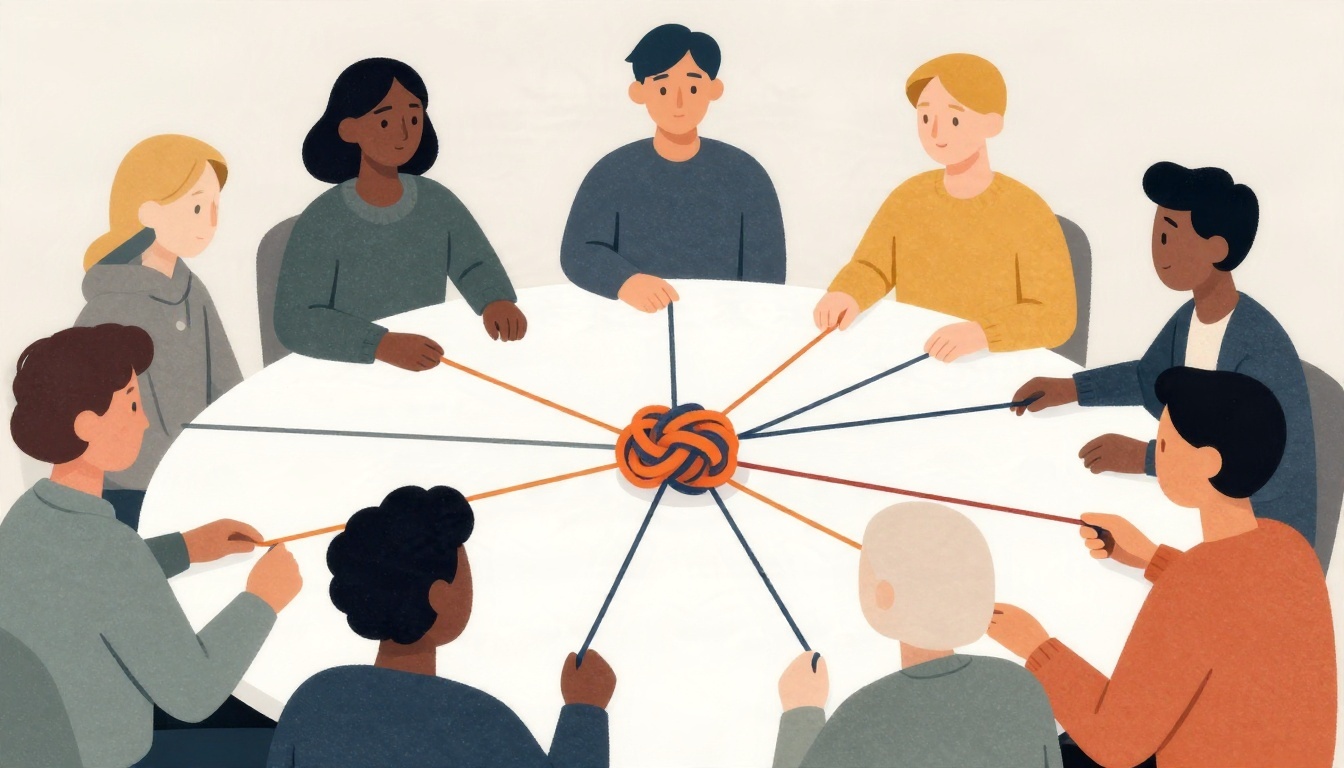
A useful distinction: consensus is the outcome — a decision everyone can live with and commit to. Consensus building is the process — the structured, collaborative effort a group uses to search for the best possible solution. Consensus building is more time-intensive than majority rule, but it tends to produce more durable decisions because people help shape the outcome and are therefore more likely to support it (Program on Negotiation).
Narrative is the tool that makes that process work. It lets people hear each other's reasoning, not just each other's conclusions.
The narrative reframing method
Use this sequence in a single facilitated session. It works best with a trained facilitator when the team doesn't already have strong conflict-navigation skills (ESIIL).
Step 1: Name the decision as a question
Write the decision on the board as an open question, not a topic. "What do we cut to hit the deadline?" rather than "Q3 roadmap." A narrative agenda frames each item as a question or decision so people know what the conversation is for.
Step 2: Collect the competing stories
Ask each person to answer three prompts in writing, then read them aloud:
- What I believe is really happening here
- What I'm afraid will happen if we choose wrong
- What I need in order to commit
This surfaces the emotional and interest-based drivers behind positions. Conflict research shows decision-making is heavily influenced by emotions, biases, and fears, and that purely logical arguments often fail to persuade — sometimes making matters worse (Conflict Conversations).
Step 3: Find the shared story
Look for what the stories have in common: shared values, shared risks, shared goals. Build the group's working narrative on those shared, positive elements before introducing the point of disagreement. A reframing approach acknowledges legitimate concerns, builds on unifying values, and then adds an element that challenges the group to think differently (Commons Library).
Step 4: Test the decision against every story
Before closing, read the proposed decision back and ask each person: does this meet what you said you needed to commit? If someone says no, return to step 3 rather than pushing to a vote.
A checklist you can run
- The decision is written as a question, not a topic
- Every participant has written and spoken their three prompts
- The shared story is stated in one sentence the group agrees on
- The proposed decision is tested against each person's stated need
- Dissent is recorded, not suppressed
- The decision is restated as the next chapter: who does what, by when
When storytelling backfires
Narrative isn't a universal fix. In high-conflict situations, giving an uninterrupted platform to someone preoccupied with blame can entrench the dispute rather than resolve it (High Conflict Institute). If a participant is locked into defending the past and blaming others, keep the prompts forward-looking and time-boxed, and consider a neutral facilitator.
How the Featured Expert Can Help
Ferran Salgado Serrano blends literary work with organizational consulting, offering narrative exploration and facilitation of team processes. His practice is suited to teams that want to bring creative thinking into their dynamics and work through disagreements with a facilitator. You can learn more at ferransalgado.com.
Quick quiz
Test your understanding of the consensus-building distinction before you run the method with your team.
{"question":"According to the Program on Negotiation, why does consensus building tend to produce more durable decisions than majority rule?","options":["Because participants help shape the outcome and are therefore more likely to support it","Because it always takes less time than a simple vote","Because it removes the need for a facilitator"],"correctIndex":0}