
According to the research, what is true about team norms over time?
Select one answer.
The problem: rules nobody wrote down
Most teams run on two rulebooks. One is written: policies, roles, meeting cadences. The other is unwritten — the shared, often-unspoken rules for "how we treat each other here" that translate values into day-to-day behavior, according to Emtrain's definition of organizational norms. The unwritten set usually wins.
That creates a practical problem for leaders. You cannot manage, question, or improve a norm you cannot see. People learn the real rules by watching what gets rewarded, what gets tolerated, and what gets brushed under the rug — and then they adjust their behavior accordingly. The result is a team that agrees on paper and diverges in practice.
Narrative gives you a way in. Stories carry the unwritten rules in a form people can hear without feeling accused, which is why storytelling is described as a cultural intervention rather than just a communication tool (Mission + Strategy).
Why norms stay invisible
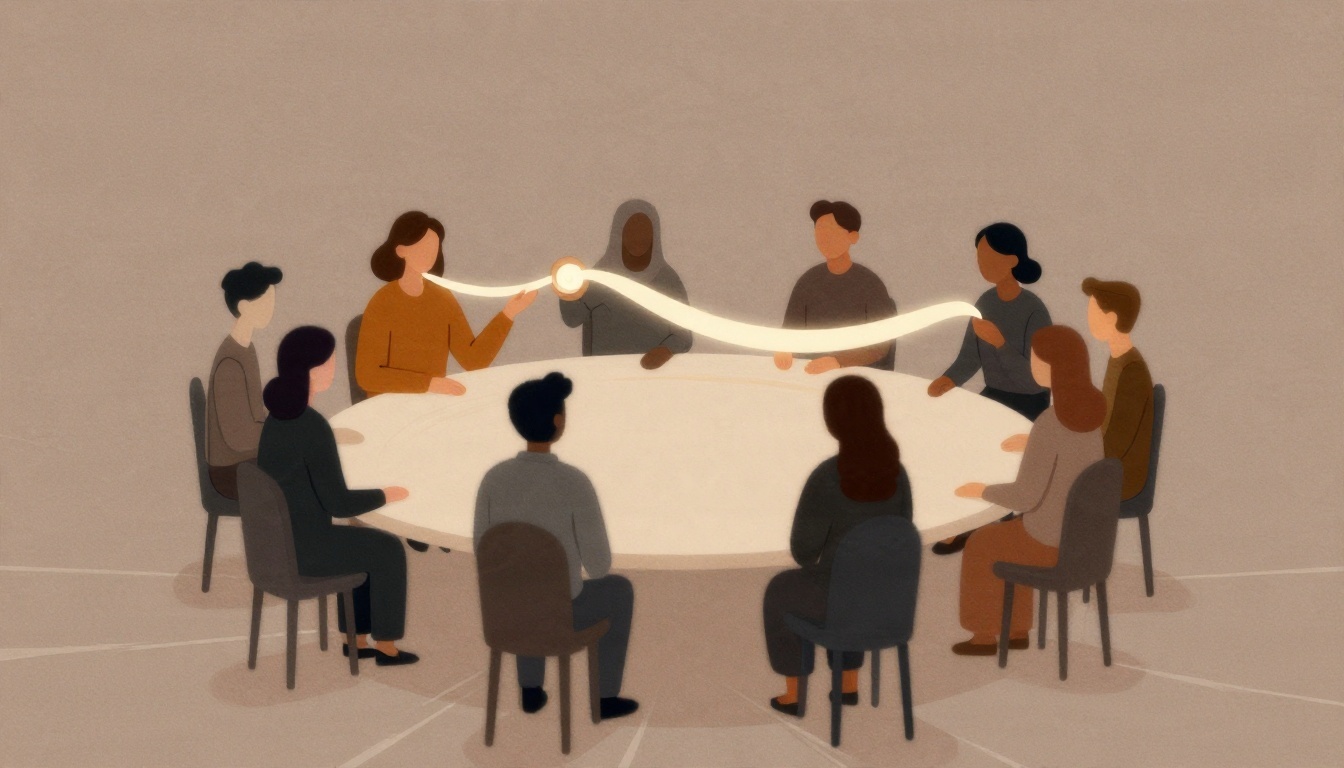
Team norms are the shared expectations, habits and standards for how members interact and work together. As Richard McLean notes in his practical guide to team norms, it is impossible for a team not to form norms over time — the only question is whether they are accidental or intentional.
Three things keep them hidden:
- They feel obvious to insiders. Long-tenured members stop noticing the workarounds they use daily.
- They are risky to name. Pointing out that bad news gets punished sounds like an accusation, so people stay quiet.
- They are behavioral, not verbal. Norms live in small acts — camera on or off, who speaks first, whether mistakes get discussed or hidden.
Use stories to surface the rules
The move is to collect concrete episodes rather than opinions. A story about a specific moment — a meeting, a deadline, a mistake — carries the norm inside it without requiring anyone to defend a position.
Step 1: Frame the session honestly
Tell the team the goal is to make existing norms visible and discussable, not to grade anyone. Make clear that naming a norm does not commit the team to keeping it.
Step 2: Ask story-based prompts
Replace abstract questions with narrative ones:
- "Tell me about a time someone on this team raised a problem early. What happened next?"
- "Describe a moment when a new person learned how things really work here."
- "Tell me about a decision that got made without the people it affected."
Step 3: Listen for the rule inside the story
After each story, ask the group: what did that story teach a newcomer about how to survive here? Write the answers down verbatim. You are collecting norms, not resolutions.
Step 4: Sort and name them
Group the answers into themes — how we show up, how we speak up, how we sort things out. Give each a plain-language name. This is the step that turns anecdote into a working document.
Step 5: Test each norm against intent
For every norm, ask two questions: does this help us do the work well, and does it match what we say we value? Keep what serves you, rewrite what does not, and retire the rest explicitly.
Step 6: Publish and revisit
Write the agreed norms down and revisit them on a schedule. The Center for Creative Leadership's guide to team norms frames norms as clear, agreed-upon behavior covering how work gets done and what members can expect of each other — which only holds if the document stays alive.
A quick checklist before you start
- Choose a facilitator who is not the team's manager, so people can speak freely.
- Collect stories in small groups first; large rooms reward the loudest voice.
- Record norms as behaviors, not values ("we say when we disagree in the meeting" beats "we value candor").
- Separate surfacing from deciding — do not fix norms in the same session you reveal them.
- Set a review date within the quarter.
Common traps
Skipping straight to new norms. If you write aspirational rules without surfacing the existing ones, the old unwritten rules simply continue underneath. Treating the exercise as a complaint session. Keep returning to the story and the rule it teaches. Letting the manager author the list. Norms that are handed down get compliance, not ownership.
How the Featured Expert Can Help
Ferran Salgado Serrano is a writer and consultant who blends literary work with organizational consulting, offering narrative exploration and facilitation of team processes. His practice combines creative narrative work with hands-on facilitation, which fits teams that want to surface unwritten norms through story rather than through a standard workshop template. You can see his literary projects and professional services at ferransalgado.com.
Quiz: check your understanding
Before you run the session, test one core idea.
{"question":"According to the research, what is true about team norms over time?","options":["It is impossible for a team not to form norms, so the only question is whether they are accidental or intentional","Teams only develop norms when a leader writes them down formally","Norms disappear once a team has a written charter"],"correctIndex":0}