
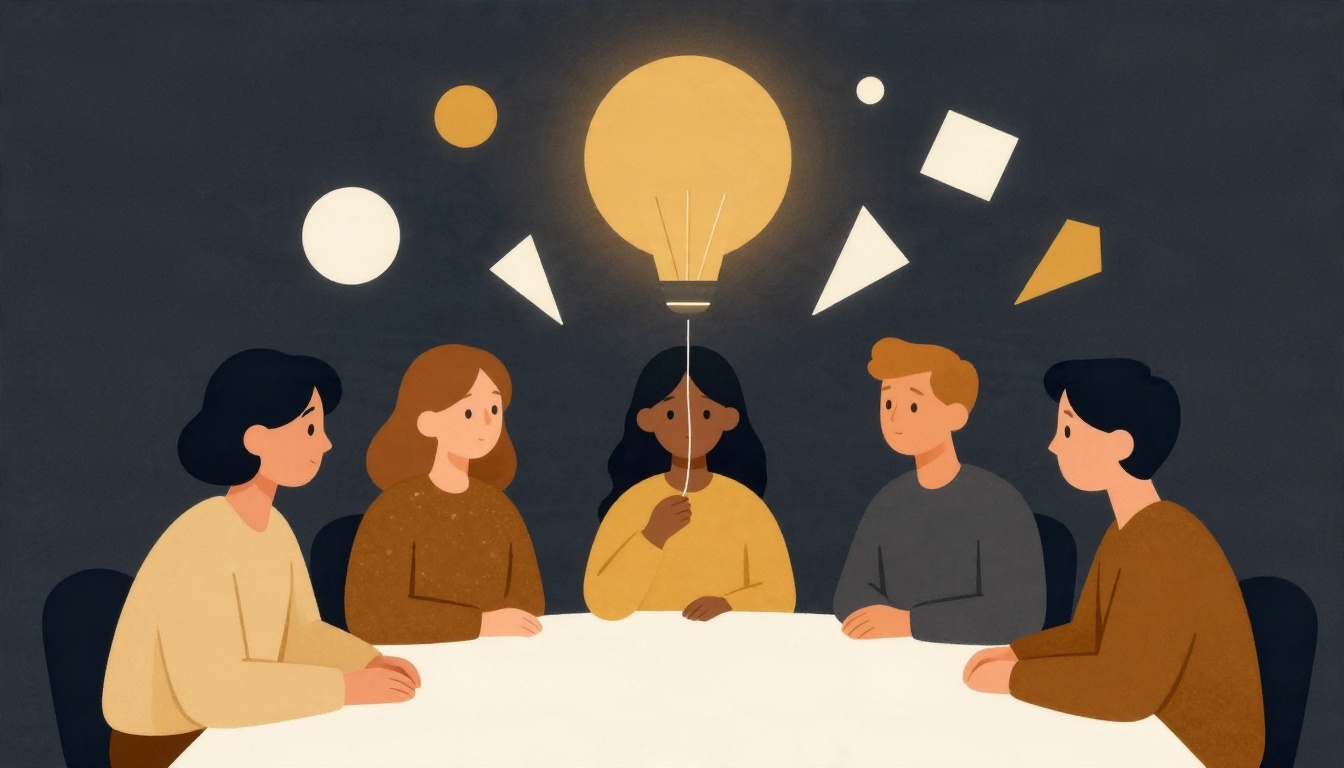
Most team meetings fail for a simple reason: they deliver information but give people nothing to hold onto. Facts alone rarely move behavior. As one training practitioner puts it, humans are "narrative animals" who respond to meaning, emotion, and connection in ways that strategy decks and metrics alone cannot achieve (Training Magazine). The fix isn't a longer agenda. It's a narrative one.
This guide shows you how to redesign a recurring team meeting around story — without adding time, and without turning it into a performance.
According to research cited in the sources, storytelling can increase information retention by up to how much compared to standard information delivery?
Select one answer.
Why story beats status updates
Storytelling in leadership means creating a narrative that resonates with your employees so you can highlight important ideas, values, or core messages (Center for Leadership Studies). That is exactly what a meeting is supposed to do, and usually doesn't.
Two practical reasons to switch:
- Retention. Research cited by Okoone indicates storytelling can increase information retention by up to 22% compared to standard information delivery (Okoone).
- Action. Data struggles to drive action on complex issues because facts don't transform behavior unless they are wrapped in a story that resonates with the listener (Training Magazine).
Start with one story, not a full overhaul
The lowest-risk change is the opening. Begin each meeting with a brief story — a client story, a team story, or a relevant shared experience — to kick things off (Esther Choy). Keep it to two or three minutes and tie it to why the work matters.
You don't have to be the only storyteller. Rotate a designated storyteller each week so the narrative voice belongs to the team, not just the manager.
Build a story-based agenda
A standard agenda lists topics. A narrative agenda frames each item as a question or decision, so people know what the conversation is for. Here is a repeatable 45-minute structure:
- Opening story (5 min). One person shares a short, relevant moment from the past week.
- The "what happened" round (10 min). Each person gives one concrete update — a fact plus its human impact, not a status list.
- The decision (15 min). One agenda item framed as a question: "What do we cut to hit the deadline?" Not "Q3 roadmap."
- The "what's next" close (10 min). Restate the decision as the next chapter: who does what, by when.
- Story capture (5 min). Note one line worth keeping for the team's story library.
MIT's guidance on meeting design supports this discipline: agendas should include the topic, the method for considering it, a time limit, and the person responsible (MIT Human Resources).
Use the IRS formula to prepare fast
When you need to tell a story and have no time to craft it, use the "IRS" formula — Intriguing beginning, Riveting middle, Satisfying ending — and write it in the order beginning, ending, then middle. The ending matters most because it makes clear what you want people to take away (Esther Choy).
Bring data to life
Pair charts and metrics with a real customer or team story that shows the human impact behind the numbers. This is one of the simplest ways to make a dry report land, and it costs nothing but a sentence of context.
A quick checklist before your next meeting
- Is the opening story under three minutes and tied to the work?
- Is every agenda item framed as a question or decision?
- Does each item have a time limit and an owner?
- Is there a designated storyteller who isn't always the manager?
- Will you capture one line for the team's story library?
- Does the close restate the decision as the next chapter?
Common mistakes to avoid
- Story as decoration. If the story doesn't connect to a decision, cut it.
- One voice. Rotate storytellers so the narrative reflects the whole team.
- No ending. A story without a clear takeaway wastes the meeting's most valuable minutes.
- Skipping the close. The "what's next" is the satisfying ending of the meeting itself.
Try it this week
Pick one recurring meeting. Add a two-minute opening story and reframe a single agenda item as a decision question. Run it for three weeks before changing anything else. Small, repeatable changes are what make narrative stick as a team habit rather than a one-off exercise.
How the Featured Expert Can Help
Ferran Salgado Serrano is a writer and consultant who blends literary work with organizational consulting, offering narrative exploration and facilitation of team processes. His practice is suited to organizations that want to integrate creative thinking into their team dynamics. You can learn more about his literary projects and professional services at ferransalgado.com.