
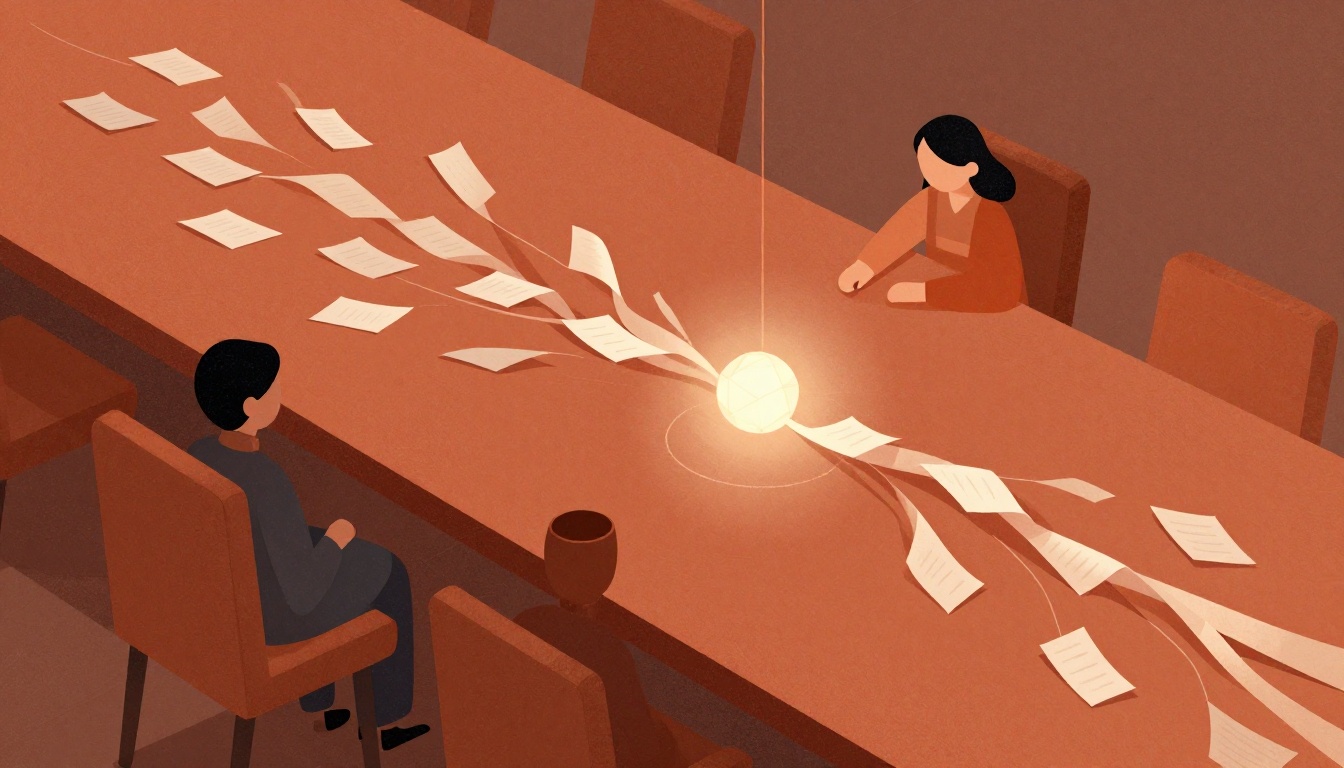
Most teams leave meetings with a decision and no shared memory of why it was made. Weeks later, someone reopens a settled question, or a new hire reads the minutes and can't tell what actually happened. The problem isn't that you didn't take notes — it's that your notes record outcomes without the reasoning that makes them usable.
Standard minutes are built to be a reference point: they help attendees recall what was discussed, decided, and assigned (BoardBook). That's necessary but thin. A decision story keeps the same facts and adds the context, tension, and outcome that let anyone reconstruct the choice later.
According to the research, how much more memorable is information delivered in narrative form compared to facts alone?
Select one answer.
Why plain minutes lose the decision
Minutes fail for three structural reasons. Decisions get mixed with discussion, so nobody can tell what was decided versus what was floated. Actions have no owner and no due date. Risks get mentioned verbally but never written down. Separating decisions, actions, and risks into distinct sections — each with an owner and a deadline — is what makes notes useful after the fact (SpryPlan).
There's also a memory problem. Information delivered in narrative form is far more memorable than facts alone, yet many leaders still rely on data presentations and bullet points to drive change (Groops). A decision story borrows that advantage without turning your minutes into fiction.
The four-part decision story
Every story — a two-minute answer in a meeting or a keynote — works through the same four parts: context, conflict, outcome, and takeaway (Karen Eber). Map those onto a decision and you get a repeatable format:
- Context: What situation forced a choice? One or two sentences.
- Conflict: What was the tension, trade-off, or disagreement? Name it plainly.
- Outcome: What was decided, by whom, and when does it lock?
- Takeaway: What should people do next, and what would reopen the question?
This is the same logic behind wrapping stories with a clear call to action so everyone understands the next steps and the reason behind the decision (LinkedIn Top Content).
A copy-paste decision story block
Use this under each decision in your minutes. Keep it to five lines.
DECISION: [Specific choice — "Launch in Q2" not "discuss launch timing"]
CONTEXT: [The situation that forced the choice]
CONFLICT: [The trade-off or disagreement, stated plainly]
OUTCOME: Owner: [one name] | Locks: [date] | Lifespan: [permanent / 90-day review / pilot]
TAKEAWAY: Next step: [action] | Reopens if: [condition]
Step-by-step: converting this week's minutes
- Pull the decisions out first. Highlight every line that states a choice rather than a discussion. If a line says "talked about pricing," it isn't a decision yet.
- Write the context in one sentence. Answer: what made this choice necessary now?
- Name the conflict honestly. Record the trade-off and, if there was dissent, the concern and why it was overruled. This is the part that prevents the decision being relitigated.
- Assign one owner and a lock date. Not "the team." One person enforces the decision, and it locks on a specific date.
- Add the takeaway and the reopen condition. State the next step and the specific trigger that would legitimately reopen the question.
- Send within two hours, confirm within twenty-four. Owners confirm their actions the next day.
Ritualize it so it survives
A format only works if it becomes a habit. Integrate stories into onboarding, team meetings, retreats, and leadership development — ritualizing storytelling reinforces culture over time (Mission + Strategy).
Two lightweight rituals do most of the work:
- Open each meeting by reading last week's decision stories aloud. Thirty seconds each. It re-anchors the team and catches drift early.
- Rotate the note-taker. When everyone writes decision stories, everyone learns to listen for the reasoning, not just the outcome.
Common mistakes to avoid
- Turning minutes into narrative fiction. A decision story is structured fact, not scene-setting. No invented dialogue, no dramatized characters.
- Burying the decision in the story. Lead with the decision line, then the context. Readers scan for the choice first.
- Skipping the conflict. Without the trade-off, the decision looks arbitrary and gets reopened.
- Leaving owners vague. "The team" owns nothing. One name, one date.
Quick checklist
- Every decision has its own block
- Context is one sentence
- Conflict names the trade-off
- One owner, one lock date, one lifespan
- Takeaway includes a reopen condition
- Minutes sent within two hours
- Owners confirm within twenty-four hours
How the Featured Expert Can Help
Ferran Salgado Serrano is a writer and consultant who blends literary work with organizational consulting, offering narrative exploration and facilitation of team processes. His practice is suited to teams that want to integrate creative thinking into how they work together. You can explore his literary projects and professional services at ferransalgado.com.
If your team's minutes keep losing the reasoning behind its decisions, the fix is a format change, not more discipline. Start with one decision from your next meeting and write it as a four-part story. Then test it: can someone who wasn't in the room explain why the choice was made? If yes, you've built a decision story that will outlast the meeting.